The ROI formula explained with worked examples, including marketing ROI — plus what to include as 'cost' and a free ROI calculator.
ROI (Return on Investment) = (Net Return − Cost of Investment) ÷ Cost of Investment × 100 — the single most fundamental profitability formula in all of marketing and business. If you spend ₹50,000 and earn ₹2,00,000 back, your ROI is (2,00,000 − 50,000) ÷ 50,000 × 100 = 300%, a genuinely strong result by almost any standard. That's the entire formula in its most basic form — the real nuance, and where most real-world ROI calculations quietly go wrong in practice, is in precisely what you choose to count as "return" and what you choose to count as "cost," a distinction that sounds simple but trips up even experienced marketers. Here's exactly how to apply it correctly, including specifically to marketing activities, with fully worked examples in both Indian rupees and US dollars, covering common real-world edge cases.
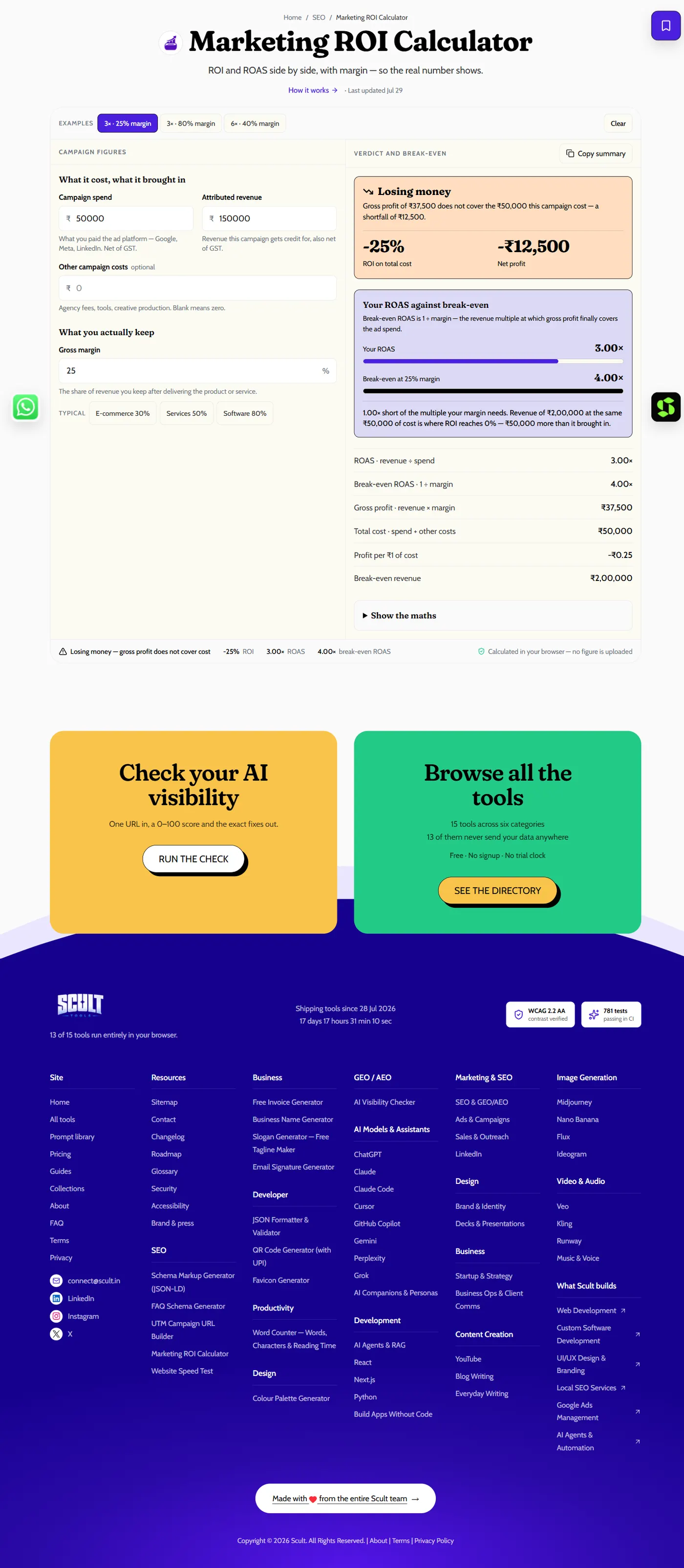
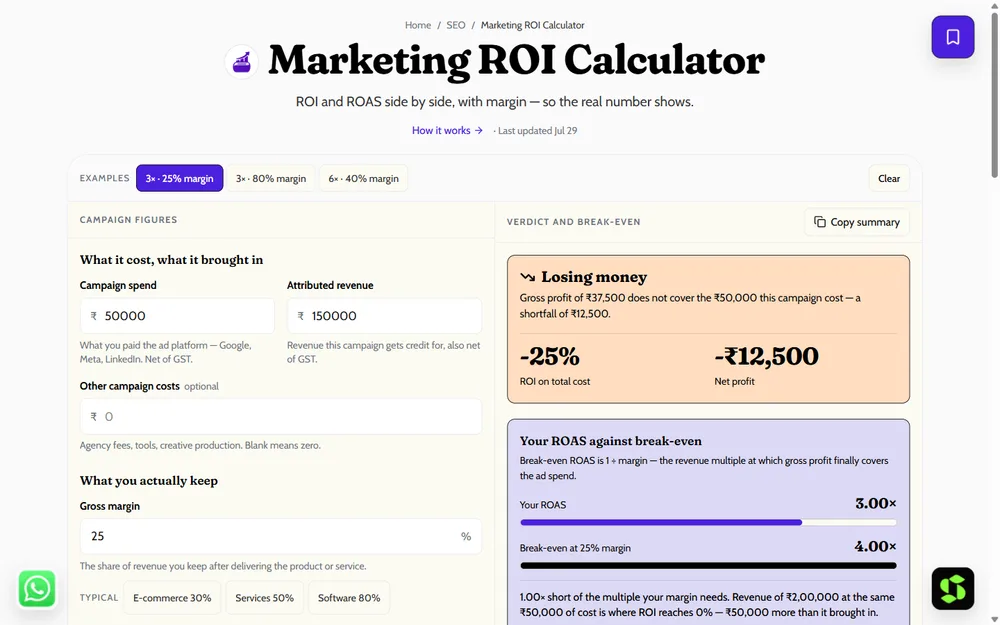
The Marketing ROI Calculator: enter spend, revenue, and gross margin, and it shows ROI, ROAS, and exactly how far a campaign is from break-even.
The ROI Formula
ROI % = (Revenue − Cost) ÷ Cost × 100
This formula, though short, is the foundation everything else in this guide builds directly on top of.
- Positive ROI — you genuinely made more than you spent; the activity was measurably profitable, a real win worth repeating and scaling.
- 0% ROI — you broke exactly even; no gain, no loss.
- Negative ROI — you lost money on the activity.
This formula works identically whether you're evaluating a marketing campaign, a piece of equipment, a hire, or any other investment — the structure never changes, only what you plug in for "revenue" and "cost."
Worked Examples
- General business investment: Spend ₹1,00,000, get back ₹1,50,000 in total → (1,50,000 − 1,00,000) ÷ 1,00,000 × 100 = a solid 50% ROI.
- Marketing campaign: A ₹40,000 campaign generates ₹1,60,000 in genuinely attributable sales → (1,60,000 − 40,000) ÷ 40,000 × 100 = an excellent 300% ROI.
- In US dollars: Spend exactly $2,000, earn back $5,000 in total → (5,000 − 2,000) ÷ 2,000 × 100 = a strong 150% ROI.
Run your own numbers instantly in the free ROI Calculator (with a ₹/$ toggle), rather than doing the arithmetic by hand every time you need a quick answer.
A Second Worked Example, With Full Cost Breakdown
To make the "what counts as cost" guidance fully concrete, here's a complete campaign broken down line by line. A business runs a festive-season campaign: ₹2,00,000 in ad spend, ₹15,000 in creative production (design and copywriting), ₹10,000 in tool and software costs for the campaign period, and roughly ₹25,000 in internal staff time (a marketer spending a quarter of their month on this specific campaign, at a fully-loaded monthly cost of ₹1,00,000). Total cost: ₹2,50,000. The campaign generates ₹9,00,000 in attributed revenue. ROI = (9,00,000 − 2,50,000) ÷ 2,50,000 × 100 = 260% — a healthy result, but notably lower than the roughly 350% figure you'd get by counting only the ₹2,00,000 media spend as cost, which is exactly the kind of overstatement this guide is warning against.
The Marketing ROI Formula, Adapted for Common Real-World Scenarios
Multi-channel campaigns: when a single campaign spans several channels (search, social, email) simultaneously, calculate ROI per channel where possible, using each channel's share of the total spend and its individually attributed revenue — a blended, single ROI figure across all channels together can hide one channel dragging the average down while another quietly outperforms.
Campaigns with delayed conversions: for B2B or high-consideration purchases where the sales cycle stretches weeks or months past the initial campaign spend, calculate ROI using a consistent lag window (30, 60, or 90 days after spend, matched to your typical sales cycle) rather than measuring revenue only within the exact campaign flight dates, which systematically understates ROI for anything with a longer path to purchase.
Recurring or subscription revenue: don't count only the first payment as "revenue" — for subscription businesses, a more honest ROI calculation uses either a fixed number of months of revenue (say, the first three or six months) or ties back to your LTV calculation, since a customer's first payment alone dramatically understates what a campaign that acquired them is actually worth.
Common Cost Categories People Forget to Include
Beyond the general "include everything" guidance above, these specific cost categories are the ones most frequently left out by accident, not by deliberate choice:
- Platform and payment processing fees — a percentage taken by the ad platform, payment gateway, or marketplace, quietly reducing net revenue before it ever reaches you.
- Returns and refunds — for e-commerce specifically, a meaningful return rate should reduce the "revenue" figure, not just the units-sold count, since a returned sale isn't real revenue after the refund.
- Discount and coupon costs — if a campaign drove sales through a discount code, the discount itself is a real cost of that campaign, not a rounding error to ignore.
- Failed or abandoned experiments — if you tested three creative variations and only one worked, the cost of the two that didn't still belongs in the campaign's total cost, not just the winning variant's isolated cost.
What Actually Counts as "Cost"?
This is where the overwhelming majority of ROI miscalculations happen. For an honest ROI figure, include every cost tied to the activity — not just the most visible one:
- Ad spend or media buy (the obvious one).
- Tools and software licensing used to run or measure the campaign.
- Agency fees or the fully-loaded cost of internal staff time spent planning, executing, and optimizing.
- Creative production costs — design, copywriting, photography, or video.
- Platform or transaction fees where applicable.
Leaving any of these out inflates your reported ROI and can make a genuinely unprofitable activity look successful on paper — which is a dangerous place to make budget decisions from.
Presenting ROI to Stakeholders Who Aren't Marketers
A raw ROI percentage means little to a stakeholder without business or marketing context, so it's worth pairing the number with what it means in practice: "300% ROI" is more persuasive and more useful framed as "for every ₹1 we spent, we generated ₹4 back — ₹3 of that being profit above what we invested." Translating the percentage into a concrete rupee-or-dollar outcome, and comparing it explicitly against what the same budget would have returned in your next-best alternative use, makes the number actionable for a non-marketing audience rather than an abstract statistic.
ROI as Part of a Broader Marketing Scorecard
No single metric, ROI included, tells the complete story on its own. A genuinely useful marketing scorecard pairs ROI with leading indicators (traffic, engagement, conversion rate) that explain why the ROI number is what it is, and with longer-term indicators (retention, LTV, brand awareness) that capture value ROI's shorter measurement window might miss entirely. Treating ROI as the single number that matters, to the exclusion of everything else, risks over-optimizing for short-term, easily-measured wins at the expense of longer-term brand and retention value that's genuinely harder to capture in a single formula.
Gross ROI vs. Net ROI
- Gross ROI uses total revenue as the "return" figure.
- Net ROI uses profit (revenue minus the cost of goods sold) as the "return" figure instead.
Net ROI is the more honest number for judging real profitability, particularly on thin-margin products — a campaign can show a large gross ROI while barely breaking even once the actual cost of what you sold is accounted for. When in doubt, calculate both, but make decisions based on net ROI.
The ROI Percentage, Explained Simply
If the formula's output confuses you as a raw number: a ratio of 0.5 (meaning you got back 1.5× what you spent) converts to 50% ROI once multiplied by 100 — the percentage is just the ratio expressed in the more commonly understood format. A ROI of 100% means you doubled your money; 300% means you got back four times what you spent (your original investment plus three more times that amount in profit).
Marketing-Specific Returns: ROI Isn't the Only Metric You Need
For advertising specifically, you'll also want ROAS (revenue per rupee of ad spend), which measures something related but distinct from ROI — see ROAS vs ROI for exactly how they differ, and what is a good ROAS for benchmarking your own number. For understanding customer-level economics beyond a single campaign, see how to calculate CAC, LTV, and payback period.
ROI in the Context of a Full-Funnel Marketing Strategy
A single-campaign ROI calculation is useful but incomplete on its own, because real customer journeys rarely trace back to one isolated touchpoint — someone might see a social ad, later click a search ad, and finally convert after an email reminder. Calculating ROI per touchpoint in isolation, using a strict last-click model, systematically under-credits the earlier touchpoints that built awareness and consideration. A more complete view calculates ROI at the campaign or channel level using a multi-touch attribution model where possible, and supplements it with assisted-conversion data — sessions where a channel appeared anywhere in the path, not only at the final click — to avoid drawing the wrong conclusion about which channels are actually contributing value.
Industry Differences in What "Cost" Typically Includes
The composition of marketing cost varies meaningfully by industry, which is worth knowing before comparing your own ROI against a generic benchmark. E-commerce cost structures are heavily weighted toward media spend and product cost of goods; SaaS cost structures lean more heavily toward the cost of sales team time and longer sales cycles; services and agency businesses often have the highest proportion of labor cost relative to media spend, since the "product" being marketed is largely time and expertise rather than a physical or digital good with a fixed unit cost.
Common ROI Calculation Mistakes
- Ignoring the time value of money for long-payback investments — ₹1 today isn't quite worth the same as ₹1 a year from now, though for most short-cycle marketing campaigns this is a minor consideration.
- Cherry-picking the measurement window — comparing a campaign's revenue against a cost period that doesn't match, inflating or deflating the resulting ratio.
- Confusing correlation with attribution — crediting a campaign with revenue that would have happened anyway, without it.
- Using gross revenue when net profit is the more honest comparison, especially for low-margin products.
- Forgetting overhead and staff time, counting only the media spend as "cost."
When Negative ROI Is Actually the Right Short-Term Outcome
Not every negative ROI signals a failure to fix immediately — a deliberate customer-acquisition push, a market-entry campaign, or an intentionally loss-leading launch promotion can carry negative ROI by design, provided there's a clear, evidence-backed plan for how that investment pays off later (through LTV, market share, or a planned follow-up phase). The distinction that matters is whether the negative ROI is a deliberate, time-boxed strategic choice with a defined payoff path, or an unplanned, ongoing drain nobody is actively addressing — treating the two identically leads to either killing a legitimately strategic investment too early, or letting a genuine problem run unchecked for far too long.
How Currency and Market Context Affect ROI Interpretation
The formula itself is currency-agnostic — 300% ROI means the same relative thing whether measured in rupees or dollars — but the absolute numbers behind it deserve local context. A ₹40,000 campaign cost is a meaningfully different commitment for a small Indian business than a $40,000 (roughly ₹33 lakh) campaign cost is for a US-based one, even though both could produce an identical 300% ROI figure. When comparing ROI across markets or reporting to stakeholders unfamiliar with a specific market's typical spend levels, pairing the percentage with the actual currency amounts involved keeps the number properly grounded rather than abstract.
What's a Good Marketing ROI?
There's no single universal target — it depends heavily on your margins, industry, and what else you could do with the same capital. As a baseline: positive ROI, and ideally comfortably above your cost of capital or the return you'd get from your next-best use of that budget. For advertising specifically, judge performance against your break-even ROAS rather than an arbitrary industry average — see what is a good ROAS for exactly how that threshold is calculated from your own margin.
Building an ROI Tracking Habit Into Your Marketing Calendar
The businesses that get the most value from ROI measurement don't calculate it once as a special exercise — they build it into a recurring cadence, reviewing ROI monthly or per campaign cycle alongside the other metrics covered in this cluster (ROAS, CAC, LTV). This turns ROI from a one-off justification exercise (calculated defensively when someone asks "did this work?") into a genuine planning tool that actively shapes where next month's budget goes, which is a meaningfully more valuable use of the same number.
A Simple ROI Reporting Template
Whether reporting to yourself, a team, or leadership, a consistent format keeps ROI reporting comparable period over period: state the total cost (broken into media spend and other costs), the total attributed revenue, the resulting ROI percentage, and one sentence of context explaining anything unusual about the period (a seasonal spike, a new channel test, a data or tracking issue). This last piece — brief, honest context — is what separates a genuinely useful report from a raw number that invites the wrong conclusion when read without it.
Calculate Yours Now
Rather than reaching for a spreadsheet and re-deriving the formula each time, use the free ROI Calculator — enter your revenue and total cost, and get an instant ROI percentage, with support for both rupees and dollars.
ROI Calculation Tools: Spreadsheet vs. Calculator vs. Full Analytics Platform
For occasional, single-campaign ROI checks, a quick calculator (like the one linked throughout this guide) is faster and less error-prone than building a spreadsheet formula from scratch each time. For ongoing, multi-campaign tracking, a shared spreadsheet template — with consistent columns for cost, revenue, and calculated ROI — scales better than recalculating individually each time. For businesses running enough marketing activity that manual tracking becomes genuinely burdensome, connecting ad platform data and CRM revenue data into a proper analytics or BI tool automates the calculation entirely, removing both the manual effort and the risk of a copy-paste error skewing an important number.
Why ROI Is the Foundational Marketing Metric
Every other financial metric in marketing — ROAS, CAC, LTV, payback period — is ultimately a more specific lens on the same underlying question ROI asks: did this investment return more than it cost? ROAS narrows the question to ad spend efficiency alone; CAC and LTV break profitability down to the individual customer level; payback period adds a cash-flow timing dimension. Understanding ROI first, and understanding it correctly (including what genuinely counts as cost), is what makes every one of those more specific metrics meaningful rather than just another number on a dashboard.
ROI Across Different Marketing Activities
The formula stays identical, but what belongs in "cost" and "revenue" shifts by activity type. For a paid ad campaign, cost is largely media spend plus creative and management time; for content marketing or SEO, cost is largely the time and tools invested in producing and promoting content, with revenue attributed over a longer, less immediate window since organic traffic compounds rather than converting instantly. For an event or sponsorship, cost includes the sponsorship fee, travel, and staff time, while revenue requires deliberately tracking which leads or sales trace back to that specific event — something that doesn't happen automatically the way ad-platform attribution does.
A Realistic Timeline for Measuring ROI
Not every marketing activity produces revenue on the same timescale, and applying an ROI calculation too early can produce a misleadingly negative number simply because the return hasn't had time to materialize yet. Paid search and shopping ads often convert within the same session, making near-immediate ROI measurement reasonable. Content marketing, SEO, and brand campaigns typically take weeks to months to show their full revenue impact, since they work by building awareness and trust that pays off over a longer buying cycle. Matching your measurement window to the activity's natural sales cycle — rather than applying one universal timeframe to everything — avoids prematurely killing a channel that simply needed more time.
Using ROI to Compare Genuinely Different Channels
A direct ROI comparison between, say, a paid search campaign and a content marketing program is fair in principle (both are ultimately measured the same way) but requires being honest about timing and attribution differences. Paid search's ROI is usually visible within days; content marketing's ROI compounds over months and is harder to attribute cleanly to a single piece of content. Comparing a three-month-old blog post's ROI against a same-week ad campaign's ROI without adjusting for this difference in maturity systematically undervalues the slower-building channel — worth keeping in mind before concluding one channel is definitively "better" than another based on a same-day comparison.
Frequently Asked Questions
What is the ROI formula, stated simply?
(Revenue − Cost) ÷ Cost × 100, expressed cleanly as a percentage figure. A positive result genuinely means the activity was profitable; exactly zero means you broke even precisely; a negative result means a real, measurable loss.
How do I calculate marketing ROI specifically?
Use the same formula with campaign revenue as "revenue" and total campaign cost — ad spend plus tools, creative, and staff or agency time — as "cost."
What is a good ROI?
It depends on the activity, your margins, and your alternatives for that capital — but positive, and ideally above your cost of capital, is the baseline. For paid ads specifically, judge against your break-even ROAS.
How do I calculate ROI as a percentage?
Multiply the raw ratio by 100 — a 0.5 return (getting back 1.5× your investment) becomes 50% ROI.
What's the difference between gross ROI and net ROI?
Gross ROI uses total revenue as the return figure; net ROI uses profit (revenue minus cost of goods) instead, giving a more honest picture of real profitability, especially on thin margins.
Should I include staff time when calculating marketing ROI?
Yes — a fully-loaded cost of internal time spent planning and running a campaign belongs in your cost figure, or your ROI will look artificially better than it actually is.
Is ROI the same as ROAS?
No — ROI accounts for all costs and expresses overall profitability; ROAS specifically measures revenue per unit of ad spend alone. See ROAS vs ROI for the full comparison.
How often should I recalculate marketing ROI?
At minimum, once per campaign cycle or per month for ongoing programs — recalculating regularly catches a declining trend early, before a full quarter of underperformance goes unnoticed.
Can ROI be negative, and what does that mean?
Yes — a negative ROI means the activity cost more than it returned, a genuine loss. It's a signal to pause, diagnose why (poor targeting, weak offer, bad measurement), and fix the underlying issue before continuing to spend at the same level.
Is there a difference between "ROI" and "return on marketing investment" (ROMI)?
Not meaningfully — ROMI is simply a more specific label for ROI applied to marketing activities specifically, using the identical underlying formula and logic covered throughout this guide.
Should agencies report ROI to clients, or is ROAS sufficient?
Agencies should report both where possible — ROAS shows ad efficiency, which agencies directly control, while ROI shows whether the client's business is actually profiting, which depends on data (margins, overhead) the agency may need the client to share.
What's the biggest single reason ROI calculations turn out to be wrong?
Undercounting cost — specifically forgetting internal staff time, tools, and creative production, all of which inflate the reported ROI and can mask an activity that isn't actually as profitable as it appears.
Can I calculate ROI for an entire year's marketing budget, not just one campaign?
Yes — the same formula applies at any scale; sum total marketing cost and total attributable revenue across the year, keeping in mind that longer time windows make clean attribution genuinely harder without solid tracking already in place.
Does ROI calculation differ for a startup versus an established business?
The formula is identical, but a startup often has less historical data to judge "good" against, and may deliberately accept lower or even negative ROI temporarily while establishing market presence — a calculated, time-boxed tradeoff rather than a miscalculation.
What's the relationship between marketing ROI and overall company profitability?
Marketing ROI measures one specific investment's return; company profitability depends on many other factors beyond marketing alone (operations, cost of goods, overhead) — a strong marketing ROI doesn't guarantee overall company profitability if other parts of the business are genuinely inefficient elsewhere.
Is there a standard software tool every business should use to calculate ROI?
Not a single mandatory one — a simple calculator or spreadsheet is sufficient for most businesses; larger organizations with many simultaneous campaigns often benefit from a dedicated marketing analytics platform instead, once manual tracking becomes a genuine bottleneck.
Want your marketing spend measured accurately and improved systematically? Talk to Scult's performance marketing team.