Proven methods to name your business — brainstorming frameworks, do's and don'ts, and how to check availability. Free generator.
To come up with a business name: start from your brand's core idea, brainstorm using proven naming methods, shortlist the ones that are memorable and easy to say, then check they're available as a company, trademark, and domain. Here's a repeatable, step-by-step process and seven naming methods that consistently work, whether you're naming a first-time solo venture or repositioning an established company.
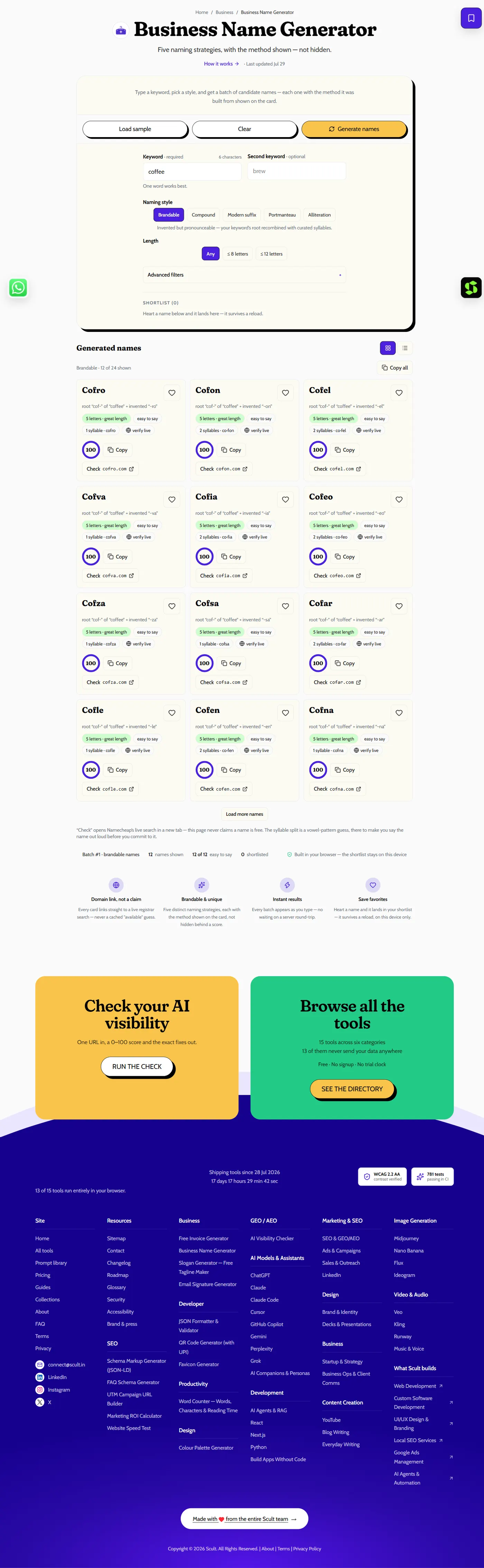
The Business Name Generator: enter a keyword and pick a naming style — brandable, compound, portmanteau, and more — and it shows the method behind every name it suggests.
Naming for a Rebrand vs a Brand-New Business
Everything in the five-step process applies to both situations, but a rebrand adds an extra input worth weighing at Step 1: what specifically about the current name isn't working, and does the new name need to solve that specific problem, or simply be an overall improvement. A rebrand driven by a trademark conflict has a narrower, clearer set of constraints (avoid the specific conflicting term and category) than a rebrand driven by "we've simply outgrown this name," which requires a more open-ended re-run of the full brainstorming process from scratch.
The Full Picture: Naming as a System, Not a Single Decision
It helps to think of naming not as one big decision made in a single sitting, but as a small system of interlocking decisions — brand definition, method selection, filtering criteria, real-world testing, and legal clearance — each of which can be done well or poorly independently of the others. A brilliant, creative name generated in step 2 is worthless if step 5 reveals it's legally unavailable. A perfectly available, legally clean name from step 5 is worthless if it fails the memorability test in step 4. Treating each step as its own small checkpoint, rather than rushing straight from "I have an idea I like" to "let's use it," is what separates a name that holds up for years from one that quietly becomes a liability within months.
Why Naming Feels Harder Than It Should
Almost everyone who's named a business describes the same frustrating experience: dozens of ideas feel either too generic, already taken, or simply flat the moment you say them out loud. Part of this is structural — a good name has to satisfy several unrelated constraints simultaneously (memorable, available, meaningful, scalable) — and part of it is that most people brainstorm randomly rather than working through a repeatable process. Naming gets dramatically easier once you separate the creative phase (generating a wide pool of raw candidates using proven methods) from the evaluation phase (filtering that pool against clear criteria) — trying to do both at once is what makes naming feel like guesswork.
Step 1: Define Your Brand Before You Brainstorm
Before generating a single name idea, get clear on three things: what you actually do, the personality you want the brand to have (serious and trustworthy? playful and approachable? premium and minimal?), and who your audience is. A name that's perfect for a playful children's product would be entirely wrong for a B2B compliance software company, and vice versa — skipping this step is why so many naming sessions produce a pile of names that don't actually fit the business once you look at them together.
Step 2: Brainstorm Widely Using Proven Naming Methods
Generate quantity first, using the seven methods below as different creative lenses — don't filter or judge ideas yet, since premature filtering is what kills a promising raw idea before it's had a chance to be refined into something better. Aim for dozens of candidates before moving to the next step; a shortlist built from a shallow pool of five or six options rarely produces a name as strong as one built from fifty.
Step 3: Shortlist for Memorability, Simplicity, and Fit
Once you have a wide pool, filter it down using three criteria: does it stick in memory after hearing it once, is it simple enough to say and spell without explanation, and does it actually fit the brand personality you defined in step 1? Cut anything that requires an explanation to "get" — a name that needs a footnote to make sense rarely earns one in the real world, where most people encounter your brand name once, in passing, with zero context.
Step 4: Test the Name Out Loud and on Others
Say your shortlisted names out loud in a real sentence — "Welcome to ___," "Thanks for choosing ___" — since names that read fine on paper sometimes stumble in actual speech. Then test them on a few people outside the naming process entirely; a name that sounds obviously great to you after hours of brainstorming can land completely differently on someone hearing it fresh for the first time, and that fresh reaction is closer to how real customers will actually experience it.
Step 5: Check Availability Before You Commit
A name you love is worthless if it's already registered, trademarked, or squatted on as a domain by someone else. Run the full availability check — company registry, trademark database, domain, and social handles — before you commit to a shortlist finalist, print it on anything, or start building a brand around it. See how to check business name availability for the complete step-by-step check across India and the US.
7 Naming Methods That Actually Work
- Descriptive — says plainly what you do (think "QuickBooks" or "General Motors"). Clear and immediately understandable, but often harder to trademark since descriptive terms get weaker legal protection, and harder to differentiate from competitors using similar descriptive language.
- Invented/coined — entirely made-up words (think "Kodak" or "Google"). Highly distinctive and easy to own legally, though it takes more marketing effort upfront since the name carries no built-in meaning — you have to build the association from scratch.
- Compound — two real words joined into one (think "Facebook," "Snowflake," "PayPal"). Often hits a sweet spot between meaning and distinctiveness, since each half carries recognizable meaning while the combination is unique.
- Metaphor/evocative — a word that suggests a feeling, quality, or association rather than describing the business literally (think "Amazon" evoking vastness, "Nike" evoking victory). Memorable and emotionally resonant, though the connection to what you actually do isn't always obvious without context.
- Founder/place-based — your own name, a founder's name, or a meaningful location (think "Ford," "Bengaluru Bakehouse"). Personal and authentic, though it can limit scalability if you later expand well beyond that founder or location's original association.
- Acronym — built from a longer descriptive phrase (think "IBM," "HSBC"). Can work well once a brand is already established and recognized, but a fresh acronym with no existing association is often forgettable and hard to differentiate from countless other three-letter combinations.
- Foreign or root words — drawing from Latin, Sanskrit, or another language's roots for a premium or distinctive feel (think many pharmaceutical and luxury brand names). Can convey sophistication, but check pronunciation and unintended meanings carefully across the languages your actual audience speaks.
Speed this whole process up by generating dozens of options at once with the free business name generator — it applies several of these naming methods automatically so you can browse a wide pool of candidates in seconds rather than brainstorming each method manually from scratch.
Do's and Don'ts of Business Naming
- ✅ Keep it short — easier to recall, type correctly, and fit cleanly into a logo or app icon.
- ✅ Make sure it can scale beyond one product, one city, or one moment in time — a name tightly tied to your first product line can box you in if the business grows or pivots.
- ✅ Say it out loud before deciding — spoken clarity matters as much as how it reads on paper.
- ❌ Avoid words that are hard to spell or easily confused with something else when heard rather than read.
- ❌ Avoid names that sit too close to an existing competitor's — beyond the branding confusion, this is also a common trigger for a trademark dispute later.
- ❌ Avoid trendy spellings (dropping vowels, adding random letters) purely for the sake of an available domain — they date quickly and complicate word-of-mouth referrals.
What Makes a Name Actually Good, Beyond Availability
Being available isn't the same as being good — plenty of available names are available precisely because nobody else wanted them. For the full breakdown of what separates a genuinely strong name from a merely free one — memorability, simplicity, distinctiveness, and the other qualities that make a name work long-term — see what makes a good brand name.
Common Naming Mistakes to Avoid
Beyond the do's and don'ts above, a few specific mistakes come up again and again in real naming projects. Naming by committee without a clear decision-maker often produces a watered-down compromise name that nobody dislikes but nobody loves either — assign one person or a small group the final call, informed by wider feedback rather than voted on by everyone equally. Falling in love with a name before checking availability wastes real time and emotional investment on an option that turns out to be legally unusable — always run at least a quick availability check before getting attached to a finalist. Choosing a name that's hard to search for online — one that collides with an unrelated common word or an already-famous brand — makes it needlessly difficult for customers to actually find you once you're searchable, which matters more than it might seem in a search-driven world.
Naming for Different Business Types
A product or app benefits from a name that's short enough to work as an app icon label and easy to say in casual conversation ("just search for ___"). A professional services firm (consulting, legal, accounting) often leans toward founder names or descriptive names that signal credibility and expertise directly. A consumer brand competing on shelf or in a crowded app store benefits most from distinctiveness and memorability, since it needs to stand out at a glance among many competitors. A B2B/enterprise software company benefits from a name that scales cleanly across multiple products and doesn't box the company into one narrow use case as the product line inevitably expands.
Naming Tools Beyond a Generator
Besides a name generator, a handful of lightweight techniques can widen your pool during the brainstorm step: a thesaurus pass on your core brand words (not to copy synonyms directly, but to trigger adjacent ideas), combining two unrelated word lists at random to surface unexpected compounds, and reviewing names in adjacent (not directly competing) industries for structural inspiration — how they balance short length against meaning, for instance — without copying their actual words. None of these replace the seven naming methods above; they're supplementary techniques for widening the raw pool before you get to shortlisting.
A Worked Example: Naming a Fictional Coffee Subscription Business
To make the five-step process concrete, walk through it for a hypothetical coffee subscription startup. Step 1 (define the brand): the business delivers freshly roasted single-origin coffee monthly, with a personality that's warm, craft-focused, and a little adventurous, aimed at coffee enthusiasts who care about origin and roast quality over convenience. Step 2 (brainstorm): using the descriptive method produces options like "Origin Coffee Club"; the compound method produces "Roastline," "Beanwave"; the metaphor method produces "Basecamp Coffee" (evoking exploration) or "Ember Roasters" (evoking warmth and craft). Step 3 (shortlist): "Beanwave" and "Ember Roasters" survive the memorability and simplicity filter better than "Origin Coffee Club," which is accurate but forgettable and generic. Step 4 (test): saying "welcome to Ember Roasters" out loud reads naturally, and a handful of test listeners consistently associate it with warmth and craft, matching the intended brand personality. Step 5 (check availability): a quick check confirms the domain, trademark class for food/beverage, and social handles are all clear, so "Ember Roasters" becomes the final name. This is the exact same five-step sequence applied to a real (if hypothetical) naming decision, start to finish.
Naming Mistakes Specific to Certain Business Types
Solo founders often default to their own name out of convenience, without weighing whether it fits the brand personality or scales if the business eventually grows a team and identity beyond its founder — worth a deliberate decision rather than a default.
Startups seeking funding should weigh whether an overly narrow or trendy name will still make sense after a pivot, since early-stage startups pivot more often than founders expect at the naming stage, and a name too tightly coupled to the original idea can become a liability.
Local businesses (a single restaurant, a neighborhood studio) can lean more heavily on place-based or founder naming, since scalability beyond one location may genuinely not be the goal — but it's still worth deciding this deliberately rather than by default, in case expansion becomes a real possibility later.
How Naming Interacts With Logo and Visual Identity
A name doesn't exist in isolation — it's the foundation the rest of your visual identity gets built on top of. A short, simple name gives a logo designer more room to work with typography and icon design; a long or complex name constrains those choices more, often forcing a wordmark-only logo rather than a distinctive icon-plus-wordmark combination. It's worth having at least a rough sense of your visual direction before finalizing a name, since the two decisions genuinely inform each other rather than happening in a strict sequence.
Naming Workshops: Doing This as a Team
If more than one person is involved in the decision — co-founders, a small leadership team — running the brainstorm step as a structured workshop rather than an open-ended group chat produces meaningfully better results. Set a fixed time box (30–45 minutes is usually enough), have everyone generate names independently and silently first using the seven methods above, then combine lists before any discussion or judgment begins. This sequence — independent generation before group discussion — consistently produces a wider, less homogenous pool of ideas than a group brainstorming out loud together from the start, where the first few ideas spoken aloud tend to anchor everyone else's thinking toward similar territory.
How Long Naming Should Actually Take
For most small businesses and startups, a focused naming process — steps 1 through 5 above — can reasonably be completed within a few days to two weeks, including the availability checks. Naming decisions that drag on for months usually aren't stuck because the process is hard; they're stuck because the group hasn't agreed on clear criteria (exactly the qualities covered in what makes a good brand name) or because no single person has been given authority to make the final call. Set a deadline upfront and assign a decision-maker before you start brainstorming, not after you're already three weeks in with twelve names still in contention.
Renaming an Existing Business
Everything above applies just as directly to renaming an already-operating business as it does to naming a brand-new one, with one added wrinkle: you're also weighing the cost of losing existing recognition, search rankings, and word-of-mouth built under the current name against whatever problem is driving the rename (a legal conflict, outgrowing the original name's scope, a merger, or simply a name that's held the business back). If the driver is a legal or trademark conflict, the rename decision is largely made for you. If it's a strategic choice rather than a forced one, weigh the switching cost honestly — a rename executed well, with a clear transition plan and advance communication to existing customers, preserves far more of the original recognition than an abrupt, unexplained switch.
Generate Ideas in Seconds
Rather than brainstorming every method above manually from a blank page, the free business name generator produces dozens of candidates instantly across multiple naming styles, giving you a wide pool to apply the shortlisting criteria in Step 3 to. Nothing you enter is stored or uploaded anywhere.
Using a Name Generator as a Starting Point, Not the Final Answer
A name generator is genuinely useful for solving the hardest part of brainstorming — the blank-page problem — by instantly producing a wide pool of raw candidates across several naming styles at once. Treat its output the same way you'd treat your own brainstormed list in Step 2: as raw material to run through Steps 3 through 5 (shortlist, test, check availability), not as a finished answer to copy directly. The best results usually come from generating a large batch, picking out the two or three that genuinely resonate, and then refining or lightly modifying them by hand — a slight tweak to a generated suggestion is often enough to turn a decent option into a genuinely distinctive final name.
Frequently Asked Questions
Should I trademark my name before or after registering the company?
Either order can work, but searching for trademark conflicts before finalizing your company registration is safer — discovering a conflict after you've already registered and started operating under a name is a far more disruptive fix than catching it beforehand.
How do I know when to stop brainstorming and just decide?
Once your shortlist has two or three names that all pass the memorability and simplicity filter in Step 3 and clear the availability checks in Step 5, further brainstorming usually adds diminishing returns — at that point, the deciding factor is genuine fit with your brand personality rather than finding some theoretically perfect option that doesn't exist.
Is it a problem if my business name is similar to one in a completely unrelated industry?
Usually not — trademark protection is generally scoped to specific categories of goods and services, so a name shared with an unrelated-industry business rarely creates a real conflict. It's still worth a quick check specific to your own category before assuming this is fine.
What if I can't decide between two or three finalists?
Run all of them through the availability checks first — this alone sometimes narrows the field if one turns out to be unavailable — then get outside opinions on the remaining candidates, since a fresh, no-context reaction is often more decisive than continuing to deliberate internally among people who've already spent hours with all the options.
Is it better to brainstorm alone or with a team?
Both work, but a team benefits from generating ideas independently first, then combining lists before discussion — this produces a wider, more varied pool than brainstorming out loud together from the start, where early spoken ideas tend to anchor the whole group's thinking toward similar territory.
What's the difference between a business name and a brand name?
In practice they're usually the same word, but technically your registered business/legal entity name (what appears on official registration documents) can differ from the brand name customers actually see — many companies operate under a trade name or "doing business as" name distinct from their formal legal entity name. For most small businesses and startups, keeping the two identical avoids unnecessary complexity.
Can I change my business name after I've registered it?
Yes, though it typically involves a formal amendment process with your company registrar, updating your trademark filings if applicable, and re-establishing your domain, social handles, and marketing materials under the new name — see the renaming discussion above for what to weigh before deciding.
How do I come up with a business name?
Brainstorm widely using proven naming methods (descriptive, invented, compound, metaphor, founder, acronym, foreign-word), shortlist for memorability and simplicity, test it out loud on others, and check availability across the company registry, trademark database, domain, and social handles before committing.
What makes a good business name?
Short, memorable, easy to spell and say, distinctive, meaningful, scalable beyond your first product or location, and available legally and as a domain. See what makes a good brand name for the full breakdown with examples.
How do I check if a name is taken?
Search the company registry, the trademark database, the domain registrar, and social platforms — a name is only truly available once it's clear across all four. See how to check business name availability for the exact steps in India and the US.
Which naming method is best?
There's no universally "best" method — it depends on your brand's personality and category. Descriptive names suit clarity-first categories; invented and metaphor-based names suit brands wanting strong differentiation; compound names often balance both well.
How many name ideas should I generate before shortlisting?
Aim for dozens rather than a handful — a shortlist drawn from a wide pool of raw ideas is consistently stronger than one built from just five or six options generated under pressure to decide quickly.
Should I check trademark availability before falling in love with a name?
Yes — run at least a quick availability check as early as possible in your shortlisting process, since committing emotionally to a name before confirming it's usable wastes real time if it turns out to be unavailable.
Can I use a free tool to generate business name ideas?
Yes — the free business name generator produces a wide pool of candidates instantly across several naming styles, which you can then run through the shortlisting and availability-check steps above.
Found a name? Build the brand. Scult does naming, identity & design.