Write a memorable slogan using proven formulas — benefit, rhythm, contrast — with famous examples and a free slogan maker.
A great slogan is short, says one true thing about your brand, and is easy to remember — usually built on a clear benefit, a bit of rhythm, or a memorable contrast. You don't need to be a professional copywriter to write one; you need a reliable formula and a disciplined shortlisting process. Here's exactly how, step by step, with famous examples decoded.
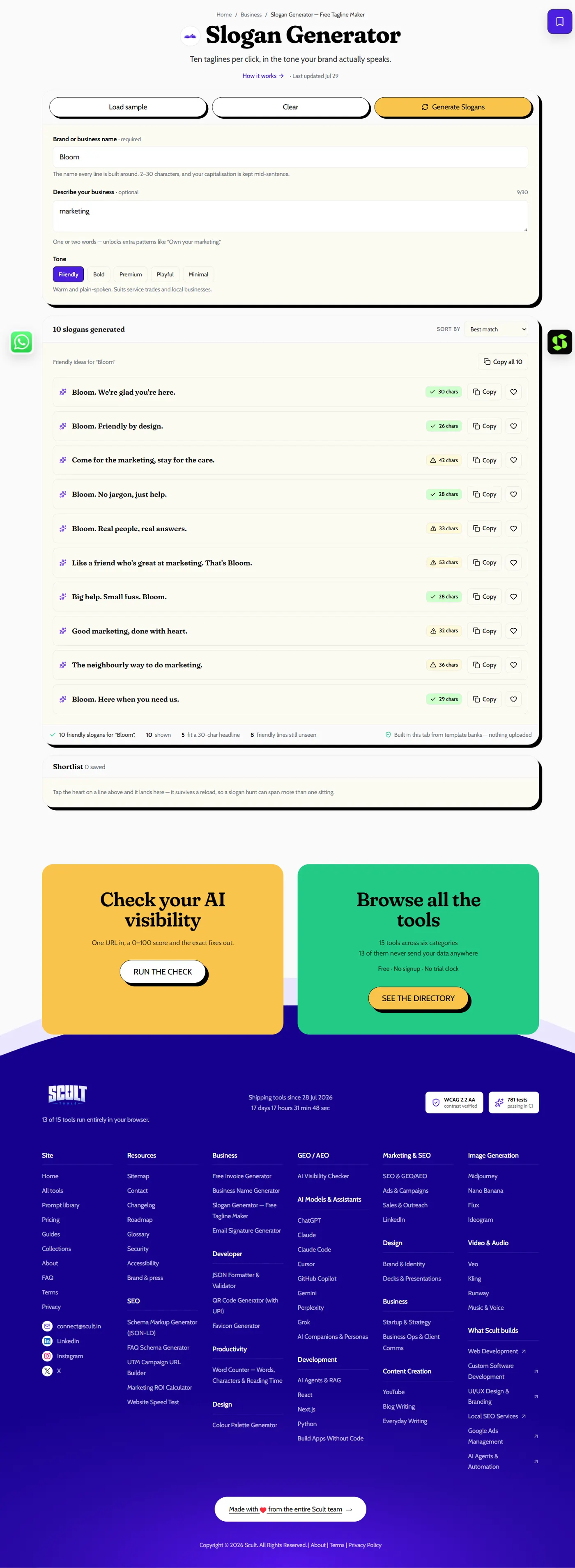
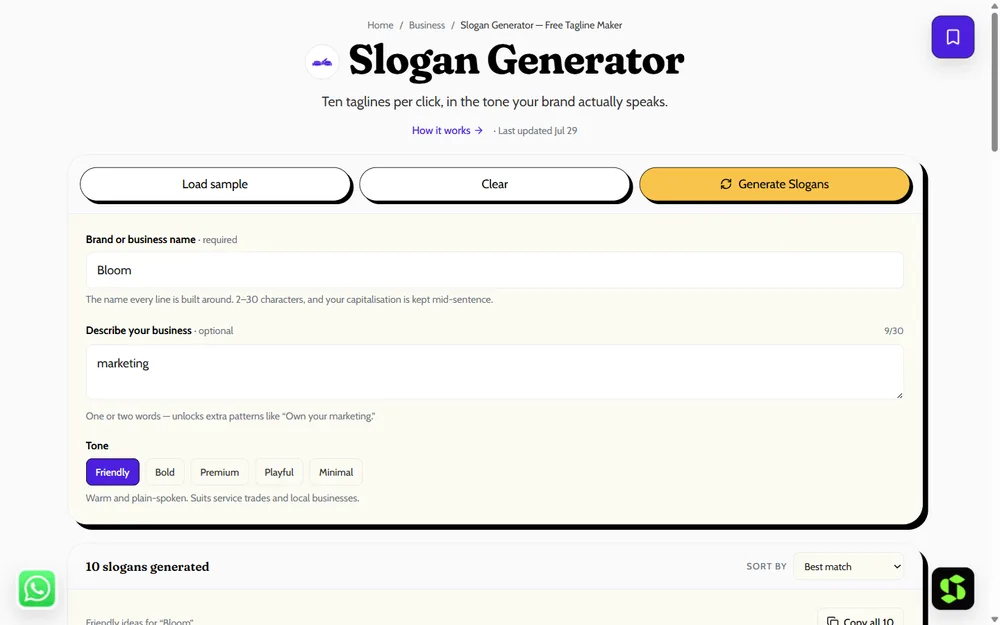
The Slogan Generator: enter your brand name and a tone, and it generates ten taglines at once.
Who This Guide Is For
This process works whether you're a solo founder writing your very first slogan, a small marketing team refreshing a tired line, or someone naming a new product line within a larger, already-established company. The five steps and five formulas don't change based on company size — what changes is how many people weigh in on Steps 1 through 4, and how much trademark diligence Step 5 warrants given how much is riding on the final line.
Slogans, Names, and Logos Are One System
A slogan doesn't do its job in isolation — it works alongside your business name and logo as three pieces of the same identity system, and the strongest results come from treating them as connected rather than sequential afterthoughts. If you haven't settled on a name yet, see how to come up with a business name first, since your slogan will draw on the same core brand definition (what you do, your personality, your audience) that naming starts from. A slogan written before the name and personality are settled often has to be rewritten once those pieces land, since the tone and positioning frequently shift once the full identity comes together.
Why Most First-Draft Slogans Fall Flat
Most people's first attempt at a slogan tries to say too much at once — the quality, the price, the values, and the outcome, all crammed into a single line. A slogan that tries to communicate everything ends up communicating nothing memorably, because there's no single idea left standing out clearly enough to stick. The slogans that actually get remembered, across every industry, share a much more disciplined pattern: one idea, expressed simply, with just enough rhythm or contrast to make it linger after the first read.
What Makes a Slogan Stick
- Short — most genuinely memorable slogans run under six words; brevity isn't a stylistic preference here, it's a functional requirement for something meant to be recalled instantly and repeated by others.
- One idea — a single, clear promise, not a list of features or benefits competing for attention within the same line.
- Benefit or feeling — what the customer actually gets, or how they're meant to feel, rather than a description of what your company does internally.
- Rhythm and sound — alliteration, rhyme, or simply a pleasing cadence when spoken aloud make a line easier to remember and repeat, even when the listener isn't consciously trying to memorize it.
- True to your brand — it should sound distinctly like your brand's voice, not a generic line that could belong to any competitor in your category with the company name swapped out.
5 Slogan Formulas That Work Reliably
- Benefit-led — state the outcome directly and plainly: "Get paid faster." This formula works because it removes any ambiguity about what the customer stands to gain, which is often the single most persuasive thing a slogan can communicate.
- Command — tell the audience to act: "Just do it." A command creates urgency and energy, and works especially well for brands built around motivation, action, or overcoming hesitation.
- Contrast — set up a clear opposition or tension: "Less, but better." Contrast formulas are memorable because the brain naturally holds onto the tension between two ideas longer than it holds onto a single flat statement.
- Rhyme or alliteration — lean on sound patterns: "Snack happy." These formulas trade some literal precision for memorability, and work best for lighter, more playful brand personalities where sounding clever matters more than sounding authoritative.
- Value or promise — state what you stand for, more abstractly: "Quietly exceptional." This formula suits brands where the promise is more about a feeling or a standard than a specific, concrete outcome.
Step 1: List What Makes You Different and Your Main Benefit
Before writing a single slogan candidate, write down — in plain, unpolished language — what genuinely makes your business different from the closest alternatives, and the single biggest benefit a customer gets from choosing you. Don't filter for cleverness yet; the goal here is raw material, not a finished line. A slogan is only as strong as the underlying truth it's compressing into a few words, so skipping this step and jumping straight to wordplay is why so many slogans end up generic rather than distinctly on-brand.
Step 2: Write 20+ Options Fast Without Judging Yet
Generate a large volume of raw slogan attempts using the five formulas above as different starting angles, deliberately withholding judgment until you have a real pool to work with. Quantity matters here for the same reason it matters in naming: the tenth or fifteenth attempt is often meaningfully better than the first three, once you've moved past the obvious, generic options that come to mind immediately. Speed this up by generating a batch instantly with the free slogan generator, then use its output as raw material to refine rather than a finished answer to copy directly.
Step 3: Cut to the Ones That Are Short, Clear, and On-Brand
From your pool of 20+, cut ruthlessly against three criteria: is it short enough to say in one breath, is the single idea instantly clear without needing explanation, and does it actually sound like your brand's voice rather than a generic line any competitor could use. Most of your raw pool won't survive this filter — that's expected and healthy; a strong shortlist of three to five finalists beats a weak list of fifteen half-decent options every time.
Step 4: Say Them Out Loud and Test on Others
Read your shortlist out loud, in context — imagine it under your logo, at the end of an ad, or spoken by someone recommending your business to a friend. Lines that read fine silently sometimes stumble when spoken, revealing an awkward rhythm or an unintended double meaning. Then test the survivors on people outside your own process; a fresh listener's immediate reaction is a far better signal of real-world memorability than your own judgment after staring at the same options for an hour.
Step 5: Check It Isn't a Competitor's Line, Then Commit
Before finalizing, do a quick search to confirm your chosen line isn't already in use by a close competitor or, ideally, isn't already a well-known slogan from an unrelated brand that could create unwanted association. This isn't the same rigorous trademark clearance a business name needs, but a quick check avoids the embarrassment (and occasional legal friction) of unknowingly reusing someone else's line. Once clear, commit — a slogan earns its value through consistent repeated use, not through being changed every few months in search of something better.
Writing a Slogan as a Team
If more than one person is weighing in — co-founders, a small marketing team — run Step 2 (generating raw options) independently before any group discussion, the same way a naming brainstorm benefits from independent generation first. Combine everyone's raw lists, then apply Step 3's filtering criteria together as a group. This sequencing avoids the common failure mode where the first option spoken aloud anchors the whole group's thinking, narrowing the eventual pool far more than an independent-first approach would.
How Long Should the Whole Process Take?
For most small businesses, working through all five steps — including generating a wide pool, shortlisting, testing on a few people, and a quick competitor check — can reasonably be done in a single focused afternoon, or spread across a few days if you want time between drafting and testing to hear the options with fresh ears. If the process is dragging on for weeks, it's usually not because the writing is hard — it's because there's no clear decision-maker, or the underlying brand definition from Step 1 was never actually nailed down clearly enough to write confidently from.
Famous Slogan Examples, Decoded
Looking at widely known slogans through the lens of the five formulas above makes the pattern concrete. A command-formula slogan works because it's short, active, and creates energy without needing further explanation. A contrast-formula slogan works because it sets up a clear tension the reader resolves in their head, which is part of why it lingers. A benefit-led slogan works because it removes all ambiguity about the payoff of choosing that brand. Across nearly every memorable slogan you can recall from memory right now, you'll find it maps cleanly onto one (sometimes two) of these five formulas — which is exactly why starting from a formula, rather than a blank page, makes the writing process so much faster and more reliable.
Using a Slogan Generator as a Starting Point, Not the Final Word
Treat a slogan generator's output the same way you'd treat your own Step 2 brainstorm: raw material to filter, not a finished line to copy verbatim. The real value of a generator is solving the blank-page problem instantly and surfacing formula combinations you might not have reached for on your own — the refinement in Steps 3 through 5 is still where a generic-sounding generated option turns into something that genuinely sounds like your brand specifically, rather than a plausible-sounding line that could belong to any business in your category.
Testing Your Slogan Beyond a Single Read
Beyond reading it out loud once, test your finalist across the actual contexts it'll be used in: does it work as a small line under a logo, does it fit naturally at the end of a 30-second ad, does it read well in a single tweet-length social post, and does it hold up printed small on a business card. A slogan that only works in its ideal, spacious presentation is a slogan with an unresolved problem, not a finished one — the same way a logo needs to survive shrinking to a favicon, a slogan needs to survive every real context it'll actually appear in.
Tagline or Slogan — Which Do You Need?
The formula and process above work for both a long-term brand tagline and a shorter-term campaign slogan, but it's worth knowing which one you're actually writing before you start, since it changes how permanent and broad the line needs to be. See tagline vs slogan for the full distinction and guidance on which one your current situation actually calls for.
A Worked Example: Writing a Slogan From Scratch
To make the five steps concrete, walk through them for a hypothetical project management app aimed at small teams. Step 1: the core difference is that it's genuinely simple to set up compared to enterprise tools, and the main benefit is that teams spend less time managing the tool and more time doing actual work. Step 2: raw attempts across the five formulas might include "Work more, manage less" (benefit-led), "Just start tracking" (command), "Simple tools, serious results" (contrast), "Plan it, ship it" (rhyme), and "Built for doing, not configuring" (value/promise). Step 3: shortlisting for clarity and brand fit narrows this to "Work more, manage less" and "Built for doing, not configuring," since both are short, communicate the core benefit clearly, and avoid the slightly awkward rhythm of the command and rhyme options. Step 4: reading both aloud under a hypothetical logo, "Work more, manage less" reads more naturally in a spoken context and tests better with a handful of outside listeners. Step 5: a quick search confirms no direct competitor is using the same line, so it becomes the final slogan. This mirrors exactly how the process should run for a real product, not just a hypothetical one.
Slogans by Business Type
Consumer products and apps tend to favor short, punchy, benefit-led or command slogans, since they're competing for attention in crowded, low-attention contexts like app store listings and social ads.
B2B and enterprise brands often lean toward value/promise or contrast formulas, which communicate credibility and positioning more than an immediate consumer-style call to action.
Local and service businesses can lean on warmth and directness — a benefit-led line that speaks plainly to the specific outcome a local customer cares about tends to outperform an abstract, clever line that requires more context to land.
Nonprofits and cause-driven organizations often favor value/promise formulas that communicate mission and belief, since the goal is usually building emotional alignment with a cause rather than driving an immediate transactional decision.
How Slogans Interact With Your Broader Brand Voice
A slogan doesn't exist in isolation — it's usually the most visible, most repeated single sentence of a brand's overall voice and tone. If your slogan is playful and your website copy is formal and dry, the mismatch creates a subtle sense of inconsistency even if a visitor can't immediately articulate why. Before finalizing a slogan, it's worth checking it against a few other pieces of your actual brand voice — your website's about page, a recent social post, your email signature line — to confirm the tone genuinely matches rather than standing apart as an isolated, more polished exception.
Common Slogan-Writing Mistakes
Trying to say too much is the single most common mistake — cramming quality, price, values, and outcome into one line dilutes all of them. Chasing cleverness over clarity produces a line that sounds impressive in the writing room but confuses a first-time listener with no context. Copying a competitor's structure too closely — using the same formula and rhythm as a well-known competitor's slogan — creates unwanted association rather than differentiation. Never testing it on anyone outside the writing process means you never find out whether the line actually lands, until it's already printed on materials and difficult to walk back.
Legal and Trademark Considerations for Slogans
Slogans can, in some cases, be trademarked just like a business name, though the bar for what qualifies as distinctive enough to protect is generally higher for a short phrase built from common words than for an invented brand name. If your slogan is central to a significant marketing investment or campaign spend, it's worth a quick trademark search in your category before large-scale rollout — the same logic and process covered in how to check business name availability applies here, adapted to searching a phrase rather than a name. ⚠️CHECK current trademark rules on slogan/phrase protectability in your specific jurisdiction, since standards vary and this is general orientation, not legal advice.
How Often Should You Revisit a Slogan?
A well-written slogan built on a genuine, lasting truth about your brand doesn't need frequent revision — constantly rewriting it undermines the very repetition that makes a slogan valuable in the first place. That said, it's worth revisiting deliberately (not reactively) if your core offering has fundamentally changed since you wrote it, if testing consistently shows it's not landing with your actual audience, or if it's become functionally identical to a competitor's line that emerged later. Outside of those triggers, resist the urge to tinker with a slogan simply because you've grown tired of seeing it — familiarity to you as the business owner isn't the same as familiarity to your audience, who likely encounters the line far less often than you do.
Slogans for Different Marketing Channels
A slogan built primarily for a website header or a printed ad may need slight adaptation for other channels: a social media bio has strict character limits that can force an even shorter variant, a voice ad or podcast sponsorship needs a line that sounds natural when spoken by a narrator rather than read silently, and a physical sign or vehicle wrap needs a line legible at a glance from a distance. Rather than writing entirely separate slogans per channel, most brands write one strong core line and make minor, channel-specific adjustments only where a hard constraint (character count, spoken clarity, visual legibility at distance) genuinely requires it.
When a Slogan Isn't the Right Tool
Not every brand communication problem is solved by a punchier slogan. If customers are confused about what your business actually does, the fix is usually clearer positioning and messaging throughout your website and materials, not a cleverer one-line summary — a slogan can reinforce clear positioning, but it can't substitute for positioning that hasn't been figured out yet. Similarly, if the underlying product or service has a real problem (poor quality, unclear pricing, a confusing purchase process), no slogan will paper over that gap in a way that holds up once customers actually experience the business firsthand.
Generate Slogan Ideas Instantly
Rather than starting from a blank page, the free slogan generator produces a wide batch of options across multiple formulas instantly, giving you real raw material to run through Steps 3 through 5 above. Nothing you enter is stored or uploaded anywhere.
Frequently Asked Questions
How do I write a catchy slogan?
Focus on one clear benefit or idea, keep it under six words where possible, and add rhythm, contrast, or a command to make it memorable. Use one of the five formulas above as a starting structure, generate a wide pool of options, then shortlist and test before committing.
How long should a slogan be?
Usually under six words — short enough that someone can recall and repeat it instantly after hearing it just once.
What's a good slogan formula?
Benefit-led, command, contrast, rhyme/alliteration, and value-or-promise are five reliable structures that cover most memorable slogans across industries — pick whichever best fits your brand's personality and the specific idea you're trying to communicate.
Do I need to hire a copywriter to write a good slogan?
Not necessarily — a clear formula, a wide pool of raw options, and honest testing on people outside your own process gets most small businesses to a strong result. Professional copywriting help is worth considering for a slogan carrying significant brand investment or campaign spend behind it.
Should a slogan describe what my business does?
Not literally — the strongest slogans communicate a benefit or feeling rather than a literal description of the product or service, since a description tends to read as flat and forgettable compared to a promise or feeling.
Can I use a free slogan generator to write mine?
Yes — the free slogan generator produces a wide batch of options across several formulas instantly, which you can then refine and shortlist using the criteria in Step 3 above.
Can a slogan change over time?
Yes, and for most businesses it's expected to — a slogan tied to a specific campaign or product is meant to be retired once that campaign ends, unlike a brand-level tagline, which is built to last much longer. See tagline vs slogan for the full distinction between the two and which one applies to your current situation.
Does a slogan need to rhyme to be memorable?
No — rhyme is only one of five reliable formulas covered above, and a benefit-led or contrast-based line can be just as memorable without any rhyme at all, provided it stays short and communicates one clear idea.
Can I reuse the same slogan across every marketing channel?
Mostly yes, with minor adjustments only where a hard constraint requires it — a strict character limit on social media, spoken clarity for audio ads, or legibility at a distance on physical signage — rather than writing a completely separate line for every channel.
What's the biggest reason a slogan fails to catch on?
Trying to communicate too much at once — cramming quality, price, values, and outcome into a single line dilutes all of them, leaving no single clear idea for a listener to actually remember and repeat afterward.
Is a slogan the same thing as a tagline?
Not quite — a slogan is usually tied to a specific campaign or product and is expected to change over time, while a tagline represents the whole brand and lasts for years. See tagline vs slogan for the complete breakdown of when each one applies.
What if my team can't agree on a final slogan?
Run every serious finalist through the testing step on outside listeners — a decisive, fresh reaction from people with no stake in the internal debate is often more useful for breaking a tie than continued internal discussion among people who've each grown attached to a different option.
Should my slogan match my competitors' style?
Not deliberately — while it's fine to use a similar formula (many strong slogans across a category lean on the same structural pattern), copying a close competitor's specific rhythm, wording, or structure too closely undermines the differentiation a slogan is supposed to provide.
How do I know if my slogan is actually good?
Test it against the "sticks" criteria above — short, one idea, benefit or feeling, rhythm, true to your brand — and get honest reactions from people outside your own process. A slogan that only sounds good to the people who wrote it is a warning sign, not a finished result.
Want a full brand voice, not just a line? Scult does branding.