Who's eligible for FAQ rich results now, how to add valid FAQ schema, and why they may have disappeared for your site.
FAQ rich results are the expandable question-and-answer dropdowns that used to appear directly under a search listing. Since Google's August 2023 policy change, they mostly appear only for well-known, authoritative government and health sites — so most sites no longer see them, even with completely valid FAQ schema. Here's exactly what changed, who's still eligible, how to set up valid FAQ schema correctly regardless, and how to troubleshoot if you think something's actually broken rather than just ineligible.
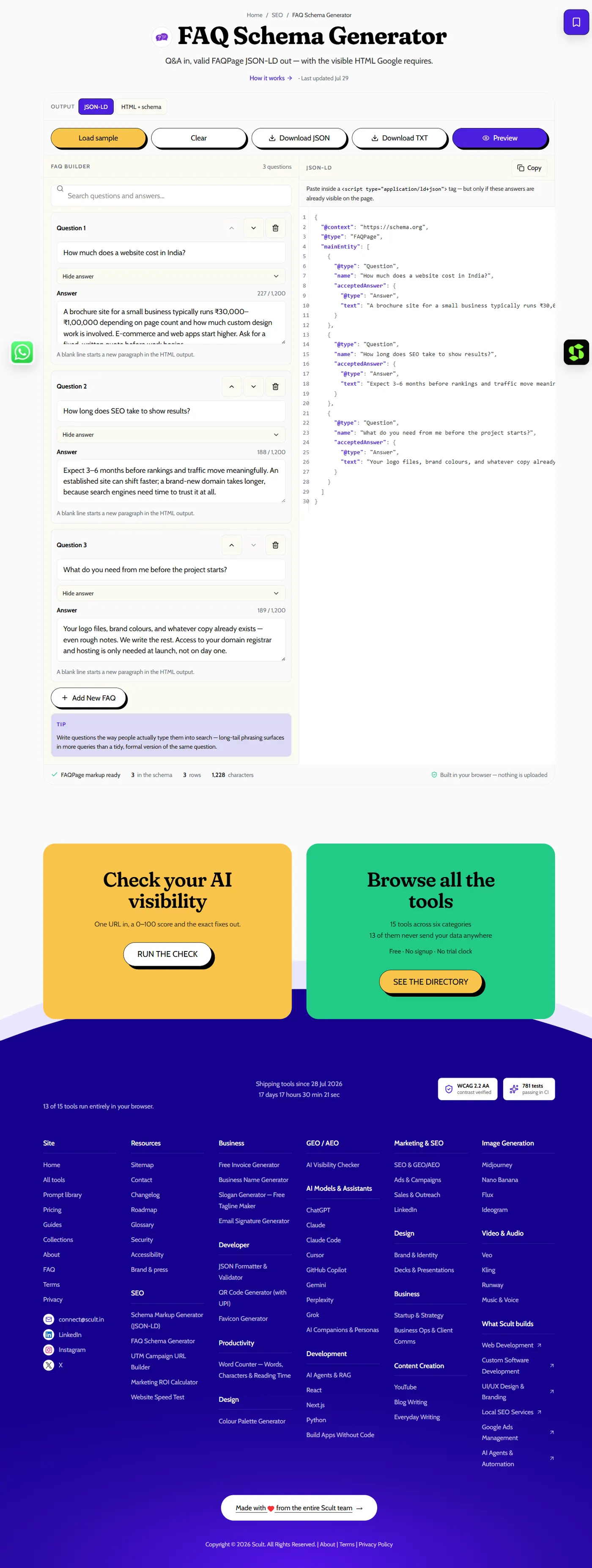
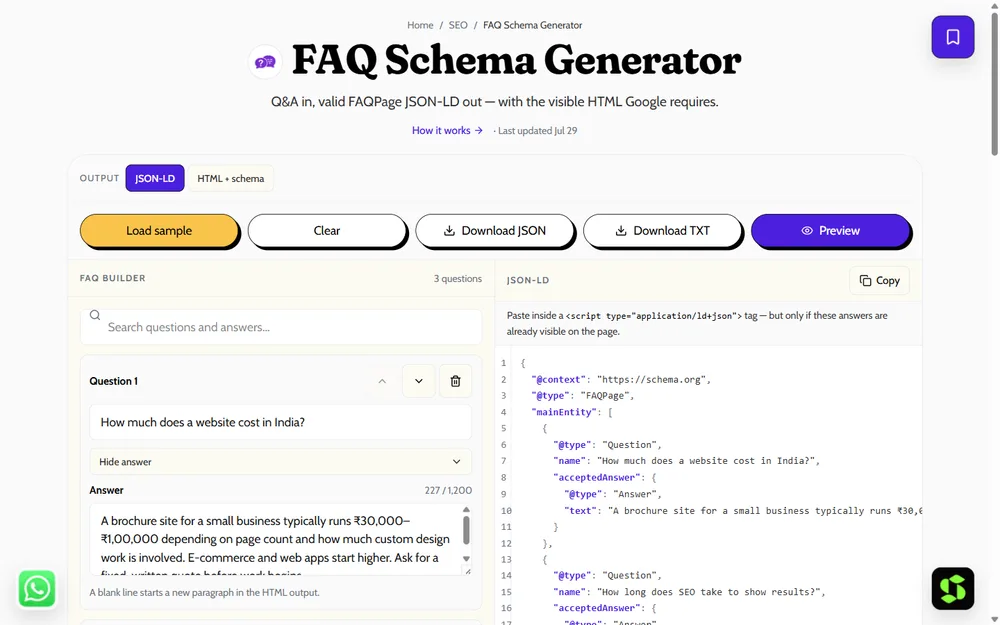
The FAQ Schema Generator: build your Q&A pairs on the left, get valid FAQPage JSON-LD — plus the matching visible HTML Google requires — on the right.
What Happened to FAQ Rich Results, Exactly?
In August 2023, Google restricted FAQ rich results to "well-known, authoritative government and health websites." If your FAQ dropdown disappeared from search results around that time, or you've since added carefully valid schema and never once seen one appear, this specific policy change is almost certainly the actual reason — not a mistake anywhere in your markup. It's worth saying plainly: your schema is very likely still structurally valid; Google simply stopped extending the visible enhancement to most site categories.
This was a narrower, more targeted change than it might sound — it didn't remove FAQPage schema as a valid Schema.org type, and it didn't stop AI systems or other consumers of structured data from reading it. It specifically narrowed which sites Google's classic search results will visually render the dropdown for.
Who's Eligible for FAQ Rich Results Now?
Realistically: primarily government and health authoritative sites, per Google's stated policy. Most commercial sites, blogs, SaaS products, agencies, and e-commerce stores fall outside this narrower eligibility, regardless of how well-implemented their FAQ schema is. If you're not in one of the still-eligible categories, it's worth recalibrating your expectations around FAQ schema's benefit away from "will show a rich result" and toward the reasons covered next.
Should You Still Add FAQ Schema? Yes — Here's Why
- AI and GEO citation. AI engines reading your page for a generated answer benefit from an explicit Q&A structure regardless of Google's classic rich-result eligibility rules — this is a separate system entirely. See FAQ schema for AI search for the deeper treatment.
- Future-proofing. Eligibility policy has changed before and could change again; sites with schema already in place lose nothing by waiting and gain instant readiness if it does.
- Content clarity. A genuinely well-organized FAQ section, marked up correctly, reinforces your content's own structure for both human readers and machines — independent of any visible search enhancement.
Step 1: Write Genuine, Visible Q&As
Start with real questions your audience actually asks — pulled from support tickets, sales conversations, or search queries you already rank for — and write direct, self-contained answers. These need to exist as real, visible text on the page itself; schema describing questions that aren't actually shown to visitors is the single most common way FAQ schema goes wrong.
Step 2: Generate the FAQ Schema
Use the free FAQ Schema Generator to turn your Q&As into valid JSON-LD. Generating it this way, rather than hand-writing the JSON, avoids syntax errors and produces the matching visible HTML at the same time — which directly satisfies Step 3 below by construction.
Step 3: Make Sure the Answers Are Visible on the Page
The text inside your acceptedAnswer schema must match text that's genuinely visible to a page visitor — not hidden behind a click-to-reveal accordion with no visible fallback text, and not paraphrased differently from what the schema states. If your FAQ section uses an expandable accordion UI, make sure the answer text is present in the page's HTML (even if visually collapsed by default), not loaded only on click.
Step 4: Validate and Request Indexing
Run the page through the generic Schema.org validator to confirm the JSON-LD is structurally correct (Google's Rich Results Test dropped its dedicated FAQPage check as eligibility narrowed, so the Schema.org validator is the more reliable structural check today). Then request indexing for the page in Google Search Console so Google recrawls it with the updated markup sooner rather than waiting for its next natural crawl.
Troubleshooting: Why Aren't My FAQ Rich Results Showing?
- Eligibility is the most likely reason. If you're not a government or health authoritative site, Google's current policy means you're simply not in the eligible category — no amount of markup correction changes this specific outcome.
- Invalid schema. Run the Schema.org validator; a missing comma or incorrectly nested object will fail silently otherwise.
- Hidden or mismatched content. The Q&A must be genuinely visible on the page, and the schema's text must match it — not a paraphrase, not hidden content with no visible fallback.
- Policy violations. FAQ markup used for advertisements or promotional content, rather than a genuine question resource, is explicitly against Google's guidelines and won't be shown regardless of technical validity.
- Recency. Even correctly implemented, newly added schema can take time to be recrawled and reprocessed — though given the current eligibility narrowing, most sites shouldn't expect the visible dropdown to appear at all, regardless of wait time.
What to Do Instead of Chasing the Rich Result
If classic FAQ rich results aren't realistically available to your site category, redirect the effort toward what still pays off: keep the FAQ schema in place for AI citation and future eligibility, invest in making the visible FAQ content itself genuinely useful (since that serves readers directly regardless of any schema), and consider whether other schema types more relevant to your content — Article, Product, LocalBusiness, Review — have better near-term rich-result eligibility for your specific site than FAQPage does right now.
A Timeline of What Changed
Before August 2023, FAQ rich results were broadly available: essentially any site with valid FAQPage schema and genuine, visible Q&A content could see the expandable dropdown under its search listing. Google's August 2023 announcement narrowed this specifically to well-known, authoritative government and health websites — a significant policy tightening rather than a gradual fade. For most site owners, the practical experience was a rich result that had been appearing for months or years simply stopping, with no corresponding change on their end. Understanding that this was a platform-wide policy shift — not something specific to your implementation — is the single most useful piece of context for anyone confused about why their FAQ dropdown vanished.
Why Google Made This Change
Google's own stated reasoning centered on search results quality and space — FAQ dropdowns were taking up significant visual real estate in results pages, sometimes for content of uneven quality, and narrowing eligibility to authoritative sources was framed as improving the overall reliability and cleanliness of what a searcher sees. Whatever the underlying motivation, the practical effect for the overwhelming majority of sites is the same regardless of the reasoning: the dropdown isn't coming back for most site categories under the current policy.
What This Means If You Run Multiple Sites or Manage Client Sites
If you're managing schema across several properties, it's worth setting expectations once, clearly, rather than fielding the same "why did this disappear" question repeatedly: FAQ schema remains worth implementing correctly everywhere, but the pitch to a client or stakeholder should center on AI citation and content clarity, not a promised rich result that's now realistically unavailable to non-authoritative sites. Overpromising the classic dropdown to a client, given the current policy, sets up an avoidable disappointment later.
Better Alternatives to Chasing FAQ Rich Results
If your site isn't in the currently eligible category, it's worth directing effort toward schema types with better near-term rich-result odds for your specific content: Product and Review/AggregateRating for e-commerce (star-and-price snippets remain broadly available), HowTo for genuine instructional content, BreadcrumbList for basic navigation enhancement, and Article for authorship and freshness signals. None of these replace what FAQ schema does for AI citation specifically, but they're a more realistic near-term source of a visible classic rich result if that's genuinely your priority.
How to Check Whether You Were Ever Actually Eligible
Before assuming your FAQ rich result "disappeared" due to the 2023 change specifically, it's worth confirming you actually had one in the first place — Google Search Console's Performance report, filtered by search appearance, shows historical rich-result impressions if you had them. If there's no record of a FAQ rich result ever appearing for your pages, the more likely explanation is a schema or content issue rather than the eligibility narrowing, and it's worth working through the troubleshooting checklist above rather than assuming policy is the sole cause.
A Realistic Set of Expectations Going Forward
Given the current policy, the honest way to set expectations for a site outside the eligible categories: budget for FAQ schema's AI-citation, clarity, and future-readiness benefits, and treat any classic FAQ rich result as a pleasant surprise rather than an expected outcome. This reframing matters practically — it changes where FAQ schema sits in a prioritized SEO task list, from "high-priority because it visibly changes the SERP" to "worth doing as part of a broader structured-data and AI-visibility strategy," which is a more accurate description of its current value for most sites.
What If Google Changes This Policy Again?
Google's rich-result eligibility policies have shifted before, in both directions, across different schema types over the years — this isn't the first time a previously broad rich-result category narrowed, and other categories have occasionally widened. There's no way to predict specifically whether or when FAQ eligibility might broaden again, but the practical implication is straightforward: sites that keep valid, accurate FAQ schema in place through this narrower period lose nothing by waiting, and gain immediate readiness with zero additional implementation work if the policy changes.
What Successful FAQ Schema Implementation Looks Like Today
Given the eligibility narrowing, "success" for FAQ schema in 2026 looks different than it did before 2023 — it's less about spotting a visible dropdown in your own search results and more about three quieter signals: your Schema.org validator check passing cleanly, your FAQ content genuinely helping readers resolve questions without needing to contact support, and — checkable directly by asking — your content being accurately cited or paraphrased when you ask AI systems the questions your FAQ section answers. None of these are as immediately visible as a rich result used to be, which is exactly why it's worth deliberately checking for them rather than assuming nothing changed.
Communicating This Change to Stakeholders Who Remember the Old Dropdown
If a manager, client, or teammate remembers FAQ rich results appearing in the past and asks why they're gone, the clearest explanation avoids relitigating whether the implementation was ever wrong: it's a documented, sitewide Google policy change from August 2023 that narrowed eligibility to authoritative government and health sites, not a technical regression. Framing it this way — a platform policy shift rather than "something we did wrong" — keeps the conversation focused on the actual, still-available benefits (AI citation, clarity, future readiness) instead of an unproductive search for a fix that doesn't exist for most site categories.
The Bottom Line
Chasing a visible FAQ rich result today only realistically makes sense if you're a government or health authoritative site; for everyone else, the practical path is implementing FAQ schema correctly for its other genuine benefits — AI citation, content clarity, future readiness — while directing effort toward schema types with better current rich-result odds (Product, Review, HowTo) if a visible enhancement is genuinely the near-term priority.
Frequently Asked Questions
Why did my FAQ rich results disappear specifically?
Google restricted FAQ rich results to well-known, authoritative government and health websites back in August 2023 — most other sites simply lost eligibility outright for the visible dropdown, regardless of whether their underlying schema was technically correct.
How do I get FAQ rich results now?
Realistically, only authoritative government and health sites are currently eligible under Google's policy. For everyone else, valid FAQ schema still helps AI search citation and keeps you ready if eligibility broadens again.
Is FAQ schema still worth implementing if I'm not eligible for the rich result?
Yes — the AI-citation and content-organization benefits apply independently of Google's classic rich-result eligibility rules.
What are the requirements for FAQ rich results?
Beyond current eligibility (government/health authoritative sites), the technical requirements are: valid FAQPage JSON-LD, answers that exactly match visible on-page text, and content that's a genuine Q&A resource rather than promotional material.
My FAQ schema validates correctly but still doesn't show a rich result — why?
Almost certainly Google's 2023 eligibility narrowing, if you're not a government or health authoritative site — validation confirms structural correctness, not rich-result eligibility, which is a separate policy decision.
Did Google remove FAQPage schema as a valid type?
No — FAQPage remains a fully valid Schema.org type, and is still read and used by AI systems and other consumers of structured data. What changed is specifically which sites Google's classic search results will visually render the dropdown for.
Should I remove my existing FAQ schema since most sites can't get the rich result anymore?
No — removing it only forfeits the AI-citation and future-eligibility benefits for no real gain, since the schema itself carries essentially no downside when it accurately matches visible content.
How do I check if my site was ever eligible for FAQ rich results in the past?
Google Search Console's Performance report, filtered by search appearance type, shows historical rich-result impressions if your site ever had them — a useful first check before assuming the 2023 policy change specifically affected you.
Is there a way to request FAQ rich-result eligibility for my site directly?
No — eligibility isn't something you can request or apply for; it's determined entirely by Google's current policy based on site category (currently, authoritative government and health sites).
Does Bing or other search engines show FAQ rich results the same way Google does?
Different search engines have their own independent policies for rich results — Google's 2023 eligibility narrowing is specific to Google's search results and doesn't necessarily reflect how other engines currently handle FAQ schema.
Will implementing FAQ schema incorrectly hurt my ranking?
Incorrect but honest schema (a syntax error, for instance) generally just fails to validate rather than causing a penalty. The real risk is markup that deliberately misrepresents content — mismatched or promotional material — which can trigger a manual action.
How long should I keep FAQ schema in place if I never see a rich result?
Indefinitely, as long as it's accurate — there's no cost to keeping valid schema live, and removing it only forfeits the AI-citation and future-eligibility benefits that don't depend on the classic rich result appearing.
Are there other schema types I should prioritize instead, given the current FAQ eligibility narrowing?
Product and Review/AggregateRating for e-commerce, and HowTo for genuine instructional content, currently have better near-term odds of a visible classic rich result — but neither replaces what FAQ schema does specifically for AI citation and content clarity.
Want to be genuinely visible in AI search, regardless of classic rich-result eligibility rules you can't control? Scult's GEO team can help you build that visibility properly, from the ground up.